
 Charles K. Millwood
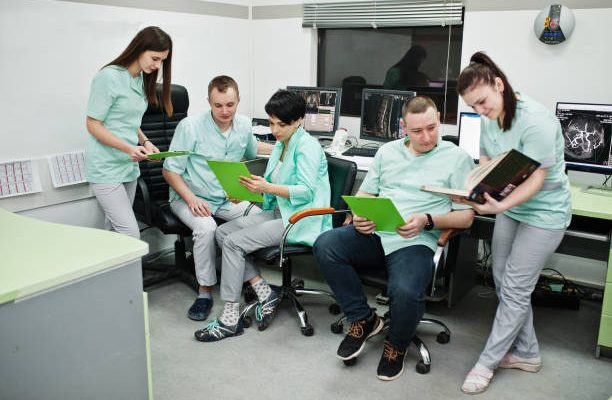
The jugular vein collapsed onto the screen as it slid open and shut like a mouth not correctly formed, as an enclave of high school students gazed at it.
“I did not expect to be doing an ultrasound today,” said Mason Christian, a 17-year-old senior of El Segundo High School, who carried out the ultrasound test that recorded the vascular activity of the neck of a classmate.
A team of about 40 El Segundo High School students, including UCLA Health anesthesiologists, had a hands-on learning experience using ultrasound technology in the Project Lead the Way. This biomedical science course aims to encourage students in high school to pursue careers in medicine.
In partnership with the California Society for Anesthesiologists, UCLA Health’s Department of Anesthesiology and Perioperative Medicine has been the pioneering force behind Project Lead the Way’s work in California since 2017. The national non-profit organization Project Lead the Way provides teachers with an educational program in biomedical sciences, and doctors and other professionals participate to mentor students and provide practical training for students.
UCLA Health conducts the program at three Los Angeles area high schools – El Segundo, Venice, and Girls Academic Leadership Academy -and acts as an example to replicate similar programs across Northern California led by Stanford and UC Davis.
In the case of Sophia Poorsattar, MD, who is the director of UCLA Health’s collaboration with Project Lead the Way, Project Lead the Way is a program that reflects her interests: mentoring, community involvement, and “inspiring students from all backgrounds to pursue advanced education and careers in biomedical fields.”
“One of the things I love most about engaging with the students is getting to witness their ‘a-ha’ moments, where the biomedical topics that they’ve learned in the classroom come to life as we discuss real-world clinical scenarios and immerse them in hands-on simulations,” Dr. Poorsattar said. “The reception has been overwhelming, with the impact felt well beyond the classroom.”
Students can connect to UCLA Health physicians, and getting an intimate look at the latest medical procedures is the main focus of the course.
“These visits are incredible,” said 16-year-old Carter Hajt, who volunteered his neck for the jugular vein ultrasound scan. “I’ve absolutely loved them.”
High school biomedical science education
The biomedical sciences program for high school students covers four years of school, introducing students to human body systems, medical interventions, and biomedical advances.
“It offers students more hands-on opportunities than any high-school level science course and sometimes more than even some early medical undergraduate courses,” said El Segundo High School teacher Tiffany Maisonet, a Project Lead the Way instructor and mentor.
“I always tell my students that I never got to do the things they are doing until I was in grad school!” she stated. “This pathway puts students in the driver’s seat by allowing them to design experiments, develop medical and forensic analysis, ask the questions they want to and, most importantly, feel like they are already members of the health care community.”
Carter stated that his lessons in classes like Project Lead the Way have already proved helpful in his daily life.
“I use it daily, honestly,” he stated. “Last summer, one of my friends got hit by a firework, which was crazy, and I had to help him using these biomedical terms.”
Mason, who conducted the ultrasound test, is a long-time fan of sciences, which attracted Mason to Project Lead the Way classes. While he had initially thought of being a neurosurgeon, his experiences in the biomedical program have helped him refine his ideas.
“I feel like I’m a lot more interested in research than being in a clinic,” Mason stated of his plan to pursue his PhD. “So I’m going to do biomed or biology in undergrad and then hopefully do research when I graduate.”
Six medical doctors are on campus.
During the El Segundo High School visit, six UCLA Health anesthesiologists fielded student questions such as “What made you want to be a doctor?” “How long are your shifts?” “What do medical schools look for?” Then, they demonstrated ultrasound technology using tiny transducers, iPads, and small ultrasound devices.
Students traveled between three stations: examining veins and arteries within the wrist and neck, studying vertebral anatomy to learn about nerve blocks and epidurals, and viewing the auditor’s heartbeat on an iPad screen.
Junior Ashlyn Sze took a turn putting the ultrasound transducer on the heart of anesthesiologist Dane Saksa, MD, to look at his heart. The students and Ashlyn identified the valves and chambers and asked questions throughout the process.
“I was astounded how (placing the probe) different places gives you different images,” said Ashlyn 16.
Ashlyn has signed up for Project Lead the Way. Project Lead the Way curriculum as she hopes to become a pediatric physician.
“This pathway has really opened me up to so many different professions that are beyond just being a doctor that you usually typically see,” she explained and added that she would like to pursue a degree at UCLA. “There’s so much more.”
In the case of UCLA Health anesthesiology resident Maryte Gylys, MD, volunteering with students was energizing and uplifting.
“It reminds me why I went into this field in the first place,” said Dr. Gylys, who said that she and many El Segundo students knew at the time of her high school graduation that she would like to pursue medical school as a career.
The students still impressed her with their sophistication and expertise.
“I was honestly very impressed by a lot of the questions that the kids were asking,” she told me. “I thought they displayed lots of curiosity and more advanced thinking. I’m not certain if I would have had the ability to ask such questions while I was in high school.”







